


The November Startup: Why Your System Smells Like Burning Dust
You flip your thermostat to "heat" on the first chilly evening of the season, expecting a rush of cozy warmth. Instead, you are immediately greeted by a concerning, acrid burning smell spreading through your air vents. A major part of home maintenance tips and troubleshooting involves knowing exactly what that sudden odor means, and more importantly, whether your house is safe. For most homeowners, this initial smell causes a spike of anxiety, prompting a rush to shut down the thermostat.
Need expert help right away? Explore our comprehensive heating services to ensure your system is ready for winter.
The truth is, not all startup smells indicate a broken heating system. In our experience at Bishop's HVAC serving the Elk Grove community, we know that during a typical November pre-winter startup, your furnace or heat pump is simply waking up from a long hibernation. Thanks to Elk Grove's extended mild weather from spring through fall, your heating elements sit completely dormant for six to eight months. During this long off-season, household dust, pet dander, microscopic skin cells, and airborne debris settle directly onto the cold heat exchanger and heating coils.
When the system finally fires up for the first time, those internal components rapidly heat up to hundreds of degrees. The accumulated layer of debris has nowhere to go, so it instantly incinerates. This process creates a distinct "toasted dust" smell that gets pushed through your ductwork and into every room of your house. It is a completely normal physical reaction to the changing seasons.
However, the line between a harmless seasonal quirk and a critical mechanical failure is thin. As a homeowner, you need to know how to self-diagnose these initial symptoms. The key to staying safe and comfortable is understanding exactly how long this burn-off should last, what specific odors signal danger, and when a strange smell crosses the boundary from a minor annoyance into a situation that requires a licensed HVAC professional.
The 15-to-30 Minute Rule: Navigating Normal Dust Burn-Off
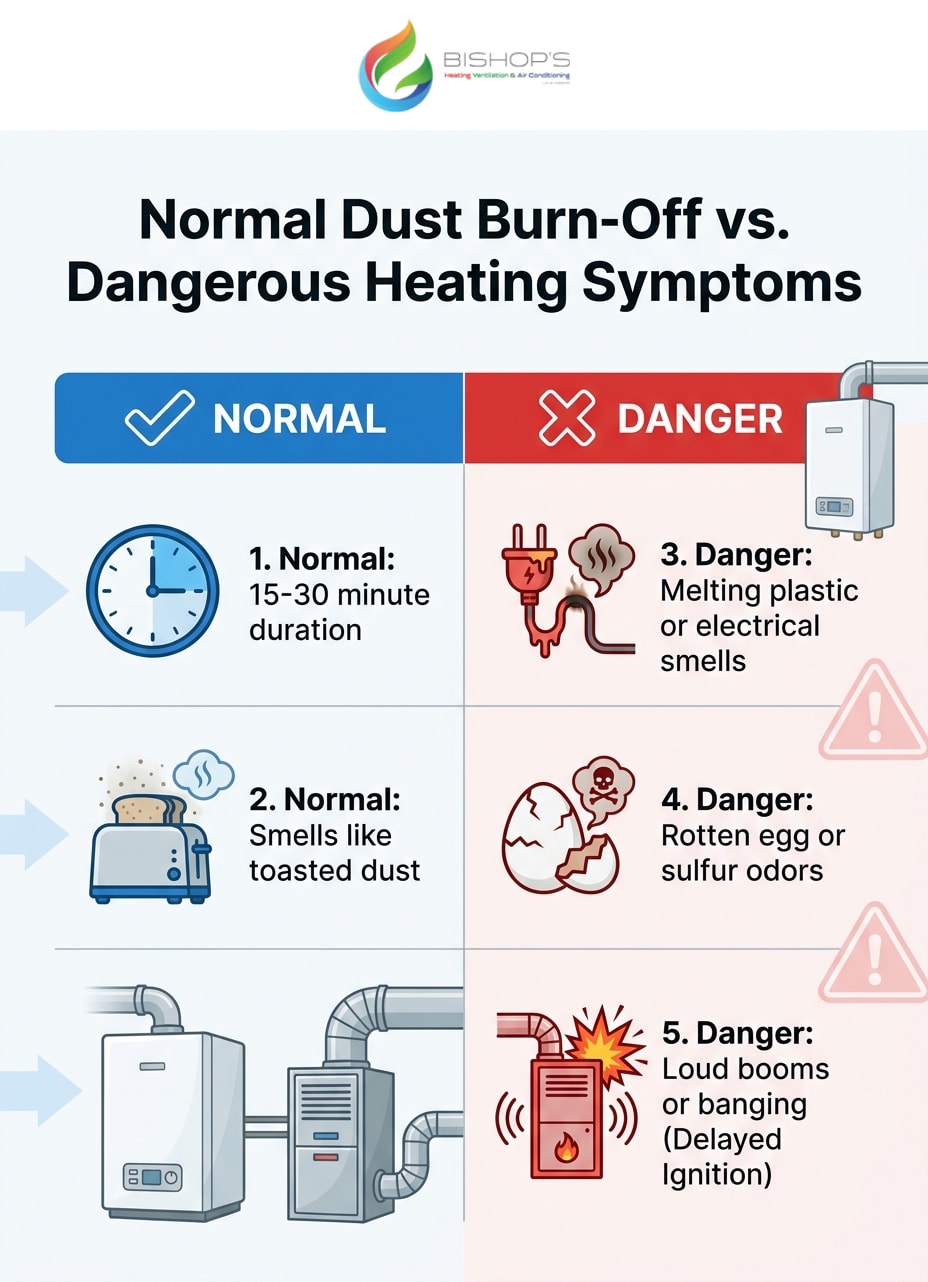
If you notice a burning smell during your first heating cycle, the most important diagnostic tool you have is a clock. Our technicians always tell customers that the physical process of incinerating off-season debris is fast. A 15 to 30 minute typical dust burn-off duration is the established baseline for a healthy, functioning HVAC system. Anything that falls within this tight window is generally considered harmless.
Here is exactly what is happening inside the metal cabinet of your furnace during those first few minutes. The thermostat sends a signal to the control board, which opens the gas valve and triggers the igniter. As the flames heat the metal heat exchanger, the static dust layer resting on the metal begins to smoke and vaporize. The blower motor then kicks on, capturing that vaporized dust and distributing it throughout your home. Because the layer of dust is microscopic, it burns away very quickly.
To safely navigate this process without panicking, follow these structured steps during your initial startup:
1. Prepare the environment: Before turning the system on, open a few windows to create cross-ventilation. This prevents the initial wave of vaporized dust from lingering in your living spaces.
2. Start the clock: Note the exact time you switch the thermostat to "heat." The 15 to 30 minute typical dust burn-off duration begins the moment warm air starts flowing from the registers.
3. Monitor the odor: The smell should resemble warm, toasted dust—similar to the scent of a space heater that has just been plugged in. It should never smell like chemicals, sulfur, or melting plastic.
4. Check the registers: Ensure that only warm air is coming out. You should never see visible smoke entering the room from your vents.
5. Evaluate at the 30-minute mark: By the time half an hour has passed, the smell should be noticeably fading or completely gone.
If the smell persists beyond this 30-minute window, it crosses the boundary from normal to abnormal. A persistent burning odor indicates that the system is continually generating the smell, rather than just burning off a static layer of summer dust. If you find yourself in this situation, it may be time to consider a professional evaluation or even a furnace replacement if the unit is severely degraded.
Warning Signs: When an Odor Indicates a Critical Problem
While a brief dust smell is harmless, your heating system can produce other odors that demand immediate action. At Bishop's HVAC, we consider the human nose an excellent diagnostic tool for HVAC troubleshooting. If you detect any of the following smells during a November pre-winter startup, you must bypass the 15-to-30 minute rule entirely and shut your system down at the thermostat.
Electrical and Plastic Burning Odors
The Problem: You smell a sharp, acrid odor that resembles melting plastic, burning rubber, or overheating electronics.
The Cause: This smell never comes from normal dust accumulation. It indicates an active electrical failure inside the cabinet. Common culprits include a failing capacitor, a seized blower motor that is overheating its casing, frayed wiring shorting out against the metal frame, or a damaged circuit board. When electrical components draw too much amperage, their protective plastic and rubber casings begin to melt.
The Solution: Do not wait to see if the smell dissipates. Immediately turn the thermostat to the "off" position. If the blower continues to run, cut the power directly at your home's main electrical breaker panel. Operating a heating system with melting electrical components is a severe fire hazard. Leave the system off until a licensed technician can test the voltage and replace the compromised parts.
Gas and Sulfur Smells
The Problem: You notice a distinct scent of rotten eggs, sulfur, or raw garbage coming from the vents or lingering near the indoor unit.
The Cause: Natural gas is naturally odorless and colorless. Utility companies add a harmless chemical called mercaptan to the gas supply specifically to give it that unmistakable rotten egg smell. If you smell this, you have a raw gas leak. This can occur due to a stuck gas valve, a cracked fitting, or a failure in the combustion chamber.
The Solution: Gas odors are never part of a normal seasonal startup. Do not turn on lights, use your cell phone near the unit, or attempt to find the leak yourself. Evacuate the house immediately, leaving the door open behind you. Once safely outside, call your local utility company's emergency line or 911. Only after the gas company has cleared the home should you contact an HVAC professional to repair the underlying equipment failure.
Musty or Dirty Sock Smells
The Problem: The air smells damp, stale, or similar to a locker room.
The Cause: This typically indicates biological growth inside your system. Over the summer, condensation from your air conditioner can pool in the drain pan or dampen the indoor evaporator coil. If this moisture doesn't dry completely, bacteria and mold can flourish in the dark, cool environment. When the heat kicks on in the fall, it bakes this biological growth, pushing a musty smell into your home.
The Solution: While not an immediate fire or explosive hazard, breathing in mold spores negatively impacts your indoor air quality. Schedule a professional coil cleaning and duct inspection to eradicate the growth and clear the condensate drain lines.
Understanding Delayed Ignition: A Hidden Heating Hazard
Smells are not the only symptoms to monitor during a seasonal startup. Sound is equally important. If your furnace kicks on with a loud "boom," a heavy thump, or a rattling bang that shakes the ductwork, you are likely experiencing a dangerous mechanical issue known as delayed ignition. Unlike the 15 to 30 minute typical dust burn-off duration, our repair teams warn that delayed ignition is never a normal part of the heating cycle and requires immediate professional intervention.
Delayed ignition occurs when combustible gas accumulates in the heating chamber before the igniter successfully lights it. In a healthy system, the gas valve opens and the burners ignite instantly, creating a smooth, quiet flame. When ignition is delayed, a dangerous volume of gas pools inside the enclosed metal space. When the spark finally catches, that large pocket of gas ignites all at once, creating a miniature explosion inside your furnace.
The Mechanics of Ignition Delay
To understand why this happens, you have to look at the combustion sequence. When your thermostat calls for heat, a draft inducer motor starts up to clear residual gases. Next, the hot surface igniter glows red hot (or a spark pilot engages). Finally, the gas valve opens. If the burners are coated in off-season rust, carbon buildup, or excessive dust, the gas cannot flow smoothly across the ignition source. Moisture buildup from a damp basement or a leaky flue pipe can also suppress the initial spark.
The loud boom you hear is the physical force of that delayed explosion striking the metal walls of the heat exchanger. This is not just a nuisance noise; it is highly destructive. Repeated miniature explosions stress the metal, eventually causing microscopic cracks in the heat exchanger. A cracked heat exchanger allows deadly carbon monoxide to leak out of the combustion chamber and mix with the breathable air circulating into your home.
Because the root causes involve the direct handling of raw gas lines and delicate burner orifices, you should never attempt a DIY repair. Scrubbing burners with wire brushes or misaligning the igniter by a fraction of an inch can worsen the gas flow. If you hear these common furnace noises, turn the system off and schedule a diagnostic visit with a licensed technician.
System-Specific Quirks: Furnaces, Heat Pumps, and Boilers
Not all heating systems react to the changing seasons in the same way. The type of equipment you have dictates the symptoms you might experience during a November pre-winter startup. A traditional gas furnace relies on direct combustion, while other systems use entirely different methods to generate warmth.
Forced-Air vs. Radiant Boiler Systems
A gas furnace pushes air directly over a metal heat exchanger that gets incredibly hot, making it highly susceptible to the classic dust burn-off smell. Heat pumps, on the other hand, do not use combustion at all. They transfer heat from the outside air using refrigerant. Because their internal coils do not reach the extreme temperatures of a gas burner, heat pumps rarely produce a burning dust smell. Instead, a burning odor from a heat pump almost always points to a failing electrical component or a stuck defrost board.
If your home utilizes a boiler, your startup experience will be vastly different. A boiler uses a closed-loop system to heat water or generate steam, which is then pumped through radiators or baseboard pipes. Because a boiler does not blow air through dusty ductwork, it is far less prone to whole-house dust smells. However, boilers have their own distinct startup quirks. If sediment has built up in the water tank over the summer, you may hear a loud rumbling or "kettling" noise—sounding much like a boiling tea kettle—when the system fires up. This indicates that minerals are trapping heat at the bottom of the tank, a problem that requires a professional system flush.
Comparing Seasonal Startup Symptoms by System Type:
• Gas Furnace — Typical Startup Symptom: Toasted dust smell — Normal Duration: 15 to 30 minutes — When to Call a Pro: Smell persists beyond 30 mins, or loud booming noises occur.
• Heat Pump — Typical Startup Symptom: Brief musty odor (from sitting idle) — Normal Duration: Less than 10 minutes — When to Call a Pro: Any burning plastic or electrical smells; system stuck in defrost mode.
• Boiler System — Typical Startup Symptom: Mild expansion ticking in pipes — Normal Duration: Intermittent during heating — When to Call a Pro: Loud kettling/rumbling, visible water leaks around the base.
One typical pattern our Bishop's HVAC team sees involves older equipment struggling to adapt to the new season. For example, a local Elk Grove homeowner reached out to us on a Sunday morning last winter because their 30-year-old furnace was exhibiting severe, prolonged startup issues. By professionally evaluating the aging unit rather than attempting temporary patches, we were able to provide clear, safe options for system sizing and fuel types—even noting how generic federal tax credits and local utility incentive programs might apply to qualifying high-efficiency upgrades—helping them transition to a reliable system before a complete mid-winter breakdown. If your system is over 15 years old, seasonal quirks often escalate into permanent failures.
If you are considering moving away from combustion heating entirely, exploring heat pump systems can offer a cleaner, quieter startup process without the anxiety of gas-related odors.
Safety First: Transitioning from Self-Diagnosis to Professional Repair
Troubleshooting your home's heating system is about knowing where your responsibilities end and a professional's begin. As a homeowner, your role is to monitor the initial startup, ensure the environment is ventilated, and observe the 15 to 30 minute typical dust burn-off duration. If the symptoms resolve within that timeframe, you can confidently enjoy a warm, comfortable winter.
However, if you encounter electrical odors, sulfur smells, delayed ignition booms, or persistent burning scents, self-diagnosis must immediately transition into professional repair. Heating systems deal with raw combustible fuel, high-voltage electricity, and toxic exhaust gases. There is zero margin for error. A licensed technician possesses the calibrated tools required to test gas pressure, inspect the microscopic integrity of a heat exchanger, and verify that the flue is drafting carbon monoxide safely out of the home.
A recent fall service call our crew handled highlights why prompt action matters. A family reached out to Bishop's HVAC when their heater stopped working unexpectedly, creating an urgent situation with a toddler in the house. Because they called our emergency line immediately rather than forcing the system to keep running, our technician was able to find the root cause safely, accommodate an immediate follow-up visit when the system threw a secondary error code, and successfully restore reliable heat without compromising the family's safety.
At Bishop's HVAC, our goal is to provide transparent, expert guidance without using alarmist language, helping you make informed, confident decisions about your home's safety. This same safety-first mindset applies to all combustion appliances in your home. If you notice similar unusual smells or delayed ignition issues with your plumbing fixtures, prompt water heater services are just as critical for preventing hazardous failures.
Frequently Asked Questions
Why does my heater smell like burning dust when I turn it on?
This is a normal physical reaction to off-season debris. Over the spring and summer, household dust, pet dander, and airborne particles settle on your furnace's internal heating elements. When you turn the system on for the first time in the fall, those components heat up rapidly and incinerate the settled dust. The resulting vapor is pushed through your ductwork, creating a temporary "toasted" smell in your home.
How long does furnace dust burn-off take?
A normal dust burn-off cycle should last between 15 and 30 minutes. The smell is usually most intense during the first five minutes and steadily dissipates as the system runs. If the burning odor persists longer than half an hour, or if it returns every time the system cycles on, it indicates a mechanical issue rather than simple dust accumulation.
What is delayed ignition in a heating system?
Delayed ignition is a hazardous condition where gas pools in the combustion chamber before the igniter successfully lights it. This usually happens because the burners are dirty, the pilot is weak, or the igniter is misaligned. When the gas finally catches the spark, the large accumulated volume ignites all at once, creating a miniature explosion inside the unit.
What does delayed ignition sound like?
Delayed ignition typically sounds like a loud "boom," a heavy thump, or a sharp bang coming from the furnace cabinet right as the heating cycle begins. You might also hear the metal ductwork rattle from the force of the small explosion. This sound is a serious warning sign that the heat exchanger is being subjected to dangerous physical stress.
When should I call a professional for furnace smells?
You should call a professional immediately if you smell melting plastic, burning rubber, electrical ozone, or rotten eggs (sulfur). You should also schedule a service call if a standard dust smell lasts longer than 30 minutes. Never attempt to investigate gas or electrical odors yourself; turn off the system and contact a licensed technician.
Do boilers experience the same startup smells as forced-air systems?
No, boilers generally do not produce the classic burning dust smell because they do not use forced air to distribute heat. Boilers heat water in a closed-loop system and radiate warmth through pipes. However, boilers can exhibit different startup issues, such as loud rumbling or "kettling" noises, which indicate mineral sediment buildup inside the water tank that needs to be professionally flushed.
Customer Testimonials

Our experience with Bishop Mechanical has been awesome. They have quick response, and do a great job! Very friendly, and Professional!


