


Surviving Elk Grove's Late-Season Heat When Your AC Shuts Down
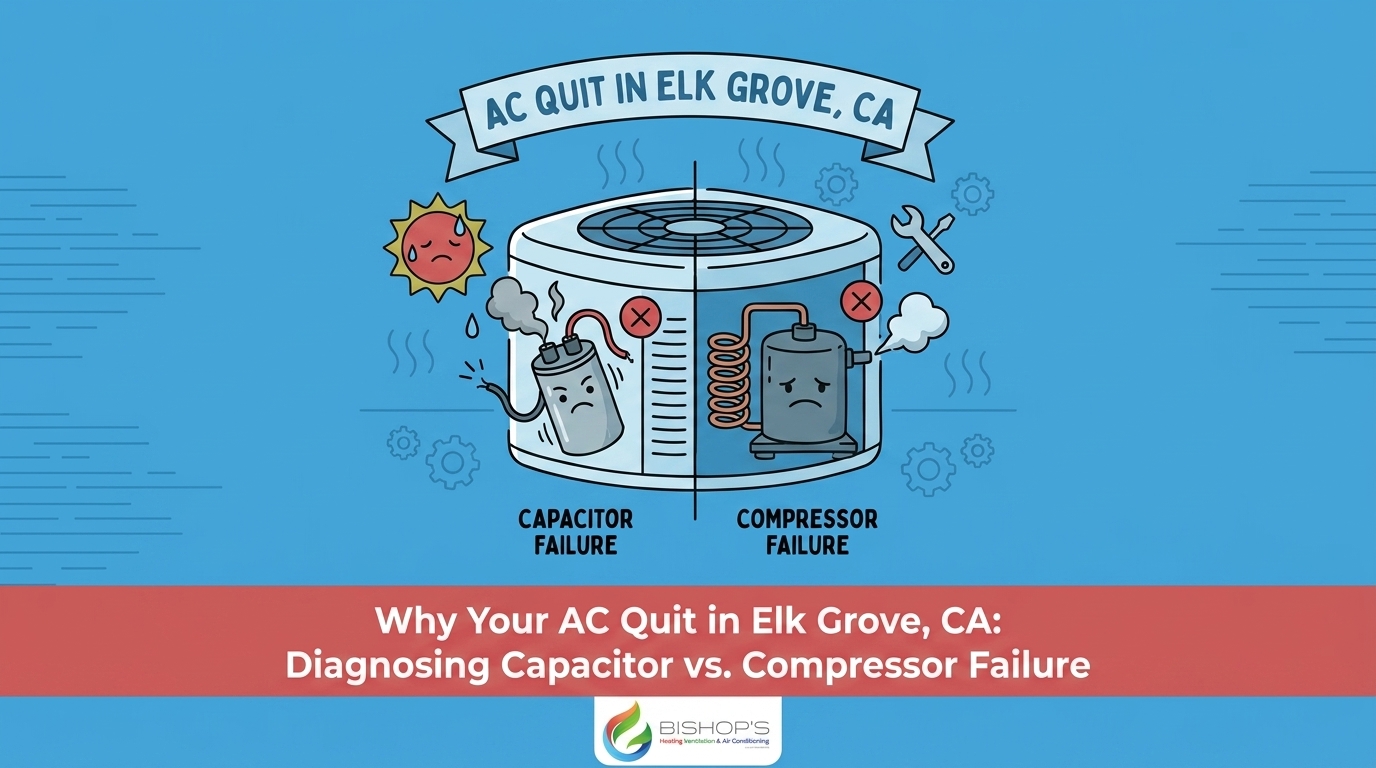
When temperatures spike unexpectedly, asking why your AC quit during Elk Grove's late heat: diagnosing capacitor vs. compressor failure becomes an urgent priority. At Bishop's HVAC, our team regularly fields emergency calls during these early fall transitions. A sudden September late-season heatwave is miserable enough, but losing your primary source of cooling turns a hot afternoon into a genuine emergency. You walk over to the thermostat, confirm it is set correctly, but quickly realize the air blowing from the vents is warm—or worse, there is no air moving at all. When an air conditioning system shuts down suddenly during extreme weather, our technicians find the issue frequently traces back to one of two vital outdoor components: the capacitor or the compressor.
Understanding the physical symptoms of these component failures helps you communicate effectively with our dispatch team while you wait for professional service. If you need immediate help with your cooling systems or want to schedule air conditioning repair and service, our team is ready to restore your home's comfort.
The Breaking Point: Cumulative Summer Wear and Late-Season Heat
Air conditioning breakdowns rarely happen without an underlying cause. By the time a September late-season heatwave arrives, our service team at Bishop's HVAC knows your cooling equipment has already endured months of grueling, continuous operation. This cumulative mechanical fatigue leaves internal parts highly vulnerable to sudden thermal stress.
The Marathon of Summer Cooling
Throughout June, July, and August, your air conditioner cycles on and off thousands of times. Every time the system starts, electrical components handle massive surges of voltage, and mechanical parts endure significant friction. This constant demand slowly degrades the internal tolerances of the machinery. Bearings wear down, electrical contacts become pitted, and the lubricating oils inside the system break down over time. When a homeowner skips their annual preventative maintenance plan—which is also the perfect time to schedule a pre-heating-season tune-up—these minor wear-and-tear issues go unaddressed, setting the stage for a sudden failure when the weather turns severe.
Pushing Past the Thermal Limit
In our years of serving the area, we've seen how Elk Grove's specific late-summer ambient temperature extremes severely impact your outdoor condenser unit's ability to dissipate heat. An air conditioner works by absorbing heat from inside your house and releasing it outside. When you face an early fall heat spike, the condenser must work exponentially harder to reject the indoor heat into an already boiling environment. This lack of efficient heat transfer causes the internal temperature of the outdoor unit to skyrocket. Components that were already weakened by months of summer operation are suddenly pushed past their maximum thermal design limits, resulting in a sudden and complete system shutdown.
What Does an AC Capacitor Do During a Late Heatwave?
To understand why your system stopped working, we often explain to homeowners the role of the AC capacitor. This small, cylindrical device is frequently the first component to surrender when extreme ambient temperatures strike the region.
The Electrical Jump-Start
Your air conditioner's compressor and outdoor fan motor require a massive jolt of electricity to start spinning—often three to five times more power than they need to simply keep running. The capacitor acts as a localized battery, storing high-voltage electricity and delivering it precisely when the thermostat calls for cooling. Without this crucial jump-start, the motors simply cannot overcome their own inertia. Recently, our Bishop's HVAC technicians responded to an Elk Grove home that experienced this firsthand when their AC unit broke down entirely during a late-season heatwave. We arrived the same afternoon, diagnosed a failed capacitor, and replaced it safely, saving the family from the extreme heat and preparing their system for the upcoming seasonal transition.
Vulnerability to Extreme Heat
Capacitors are highly sensitive to extreme heat. Inside the metal casing, a dielectric fluid separates delicate layers of conductive foil. During a September late-season heatwave, the combination of the sun beating down on the metal cabinet and the internal heat generated by the system causes this fluid to expand. The capacitor can bulge, leak, or completely lose its ability to store a charge (measured in microfarads). When a capacitor weakens but does not fail completely, it forces the compressor to draw excessive amperage to keep running, which can trigger a thermal overload and shut the entire system down to prevent a fire.
Telltale Signs Your AC Capacitor Has Failed
When a capacitor dies during a September late-season heatwave, our technicians at Bishop's HVAC look for very specific physical symptoms. Identifying these signs can help you relay accurate information to our team, speeding up the diagnostic process.
Look and listen for these distinct warning signs:
• A distinct humming or buzzing noise: If you stand near the outdoor condenser unit and hear a loud electrical hum, the motors are receiving voltage but lack the stored energy from the capacitor to actually start turning.
• The outdoor fan is not spinning: You may notice the system is humming, but the large fan blades on top of the outdoor unit remain completely stationary.
• Warm air blowing from indoor vents: Because the outdoor unit cannot circulate refrigerant or dissipate heat without the fan and compressor running, the indoor blower will simply push uncooled air throughout your home.
• The "stick" test (for observation only): Sometimes, if a technician uses a long insulated stick to gently nudge the fan blades, the motor will catch and start spinning. This confirms the motor works but the capacitor has failed. Never attempt this yourself due to the risk of moving parts and high voltage.
Because capacitors handle such high voltage, testing and replacing them requires specialized multimeters and safety training. Booking a professional ac capacitor replacement elk grove ca with Bishop's HVAC is the only safe way to resolve this issue. Attempting to swap the part yourself can result in lethal electrical shocks. For a broader look at what might be going wrong, reviewing common air conditioning repairs and costs can help set expectations before our service truck arrives.
The Role of the AC Compressor in Extreme Heat
While our team can often resolve a capacitor issue quickly, the compressor is the heavy-duty mechanical heart of your entire cooling system. In our experience working on Elk Grove homes, when this component fails during a late heat event, the repair scope changes significantly.
The Heart of Your Cooling System
The compressor's job is to pump chemical refrigerant through the copper lines that connect your indoor and outdoor units. It takes low-pressure, warm refrigerant gas from the house and compresses it into a high-pressure, incredibly hot gas. This compression process is what allows the refrigerant to release its stored heat into the outdoor air. The compressor is a complex piece of machinery featuring tightly sealed motors, internal valves, and specialized lubricating oils. It is designed to last for over a decade, but it requires a very specific operating environment to survive.
When Overheating Leads to Shutdown
During a September late-season heatwave, a compressor faces immense strain. If the outdoor coil is dirty, or if the system is low on refrigerant, the compressor loses its ability to cool itself. The internal temperature of the motor spikes. Most modern compressors feature an internal thermal overload switch designed to cut the power if the unit gets too hot. However, if the system is repeatedly subjected to extreme ambient temperatures while struggling with dirty coils or a weak capacitor, the internal windings can short out, or the mechanical valves can shatter. When a compressor dies, it means the heart of the system has stopped beating entirely.
Critical Warning Signs of Compressor Failure
A failing compressor presents much more violent and disruptive symptoms than a simple blown capacitor. When Bishop's HVAC crews respond to compressor calls during early fall heatwaves, we look for these severe indicators.
Signs of a major compressor issue include:
• Hard clicking, grinding, or shuddering: Instead of a smooth electrical hum, a dying compressor will often make a harsh mechanical grinding noise. You might even see the entire outdoor metal cabinet shudder violently when the system attempts to start.
• Immediate and repeated circuit breaker trips: If the internal electrical windings of the compressor have shorted to the ground, the unit will pull a massive, unsafe surge of electricity. This will cause your home's electrical panel to instantly trip the breaker to prevent a fire.
• The outdoor fan runs, but there is no cooling: If the top fan is spinning normally but the air inside is warm, the compressor has likely failed to engage or has suffered a mechanical breakdown internally.
• Puddles of oil around the unit: A ruptured compressor can leak its internal lubricating oil into the base pan of the outdoor cabinet.
Because the compressor is integrated into the sealed refrigerant loop, addressing these symptoms requires specialized recovery equipment and EPA certification. If you observe these severe signs, you will need a professional evaluation by the Bishop's HVAC team for an ac compressor repair elk grove ca, or potentially a full system replacement. If your home utilizes a specialized dual-system and you're thinking ahead to cooler weather, looking into heat pump repair in Elk Grove follows a very similar diagnostic process.
Capacitor vs. Compressor: A Symptom Comparison Guide
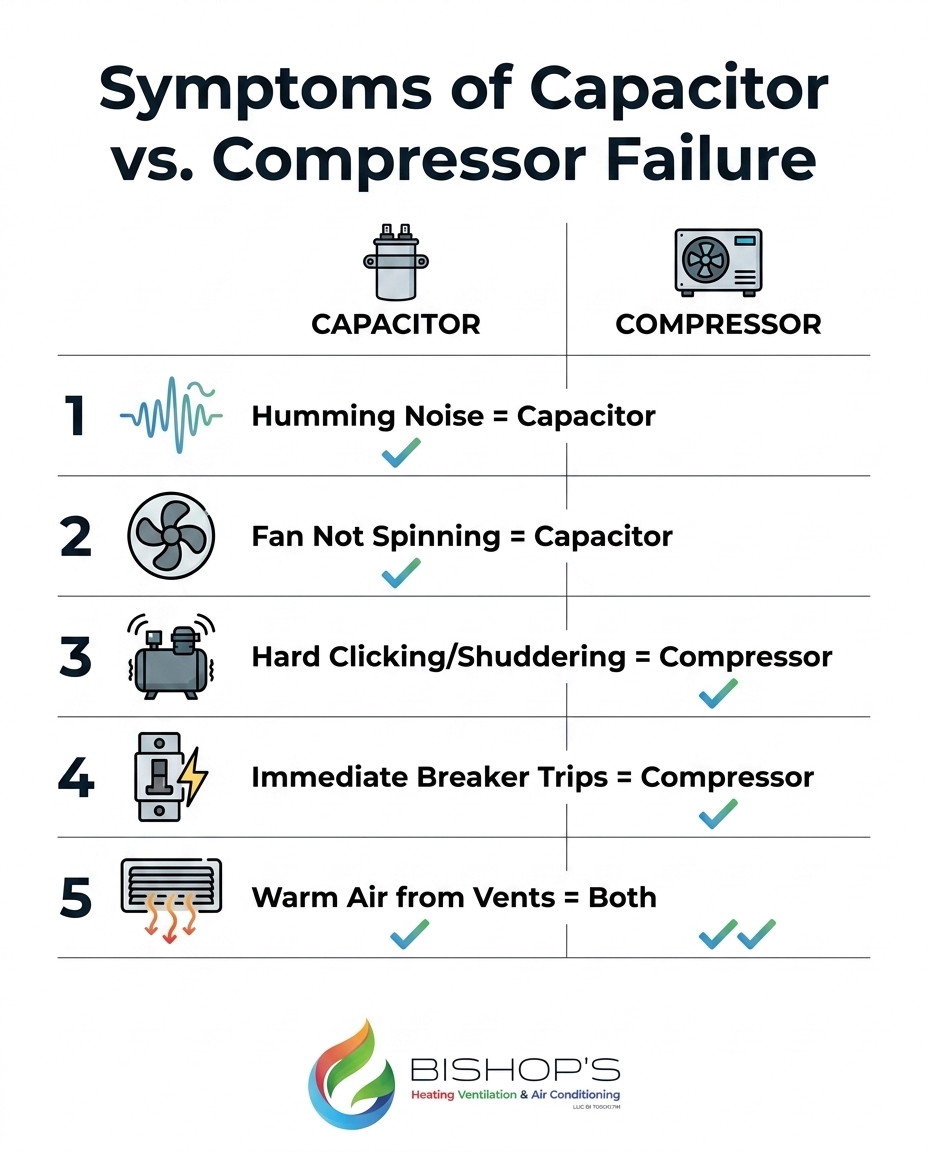
When extreme ambient temperatures strike, the resulting breakdowns can feel chaotic. Leveraging our team's direct field experience at Bishop's HVAC, we have found that giving Elk Grove homeowners a clear way to categorize the physical symptoms provides tremendous peace of mind while they wait for a technician to arrive. The table below outlines the distinct differences between these two common failures.
• Audible Noises — Likely Capacitor Issue: Continuous, steady electrical humming or buzzing. — Likely Compressor Issue: Harsh grinding, hard clicking, or violent shuddering.
• Outdoor Fan Status — Likely Capacitor Issue: Fan blades are completely stationary while the unit hums. — Likely Compressor Issue: Fan may run normally, but the system still fails to cool.
• Electrical Impact — Likely Capacitor Issue: Rarely trips the main circuit breaker. — Likely Compressor Issue: Causes immediate and repeated circuit breaker trips.
• Indoor Airflow — Likely Capacitor Issue: Warm air blows from the vents. — Likely Compressor Issue: Warm air blows from the vents.
While this comparison helps you understand what you are observing, only a licensed professional can safely open the high-voltage cabinet and make the final, definitive determination.
Frequently Asked Questions: Diagnosing AC Failures Safely
How do I know if my AC compressor or capacitor is bad?
A bad capacitor typically results in a steady humming noise with a stationary outdoor fan. Conversely, a bad compressor often causes hard clicking, violent shuddering, or immediate tripped breakers at the electrical panel. During a September late-season heatwave, paying attention to these specific sounds and behaviors is the best way to determine which component is struggling before our technician arrives.
Can a bad capacitor ruin a compressor?
Yes, running a system with a weak capacitor forces the compressor to draw excess amperage to start and run. This leads to thermal overload and potential permanent compressor damage over time. If you hear humming but the fan is not spinning, turn the system off at the thermostat immediately to protect the compressor from permanent damage.
What does a bad AC capacitor sound like?
It usually produces a distinct, continuous humming or buzzing sound from the outdoor unit. This sound indicates the motor is receiving power from the grid but lacks the initial localized jolt to start spinning. The electrical current is trapped, vibrating the internal components without creating rotational movement.
Why do AC capacitors fail in hot weather?
Capacitors store energy and are highly sensitive to thermal stress. Extended exposure to high ambient temperatures causes the internal dielectric fluids to expand, leak, or fail entirely. Because they sit inside a metal box baking in the sun while also managing high voltage, they are often the first casualty of extreme summer weather.
Why did my AC quit specifically during the September heatwave?
At Bishop's HVAC, we often explain that cumulative wear from a long summer leaves components mechanically weakened and electrically fatigued. A late-season heat spike pushes these weakened components past their breaking point. The system simply has no remaining operational tolerance to handle the sudden, massive demand for heat dissipation.
Is it safe to test my AC capacitor myself?
No, capacitors store lethal amounts of high-voltage electricity even when the main power to the house is turned off. Only licensed technicians should perform electrical testing and replacement. Attempting to discharge or remove a capacitor without proper insulated tools and training can result in severe injury or death.
Restore Your Home's Comfort Safely and Quickly
Whether you are dealing with a quick electrical swap or a major mechanical failure, our team at Bishop's HVAC believes a clear, professional diagnosis is always the first step. Recently, an Elk Grove customer called our dispatch team late on a warm Thursday evening when their system stopped functioning entirely. We arrived on Friday, quickly diagnosed the core issue, and had the exact part on hand to get everything running again, avoiding days without cool air. When an unexpected heatwave strikes, you do not have to suffer through the heat guessing what went wrong. Professional service guarantees the right fix without the electrical risks of DIY repairs. If you need air conditioning repair and service, or want to schedule a pre-heating-season tune-up, our experienced technicians are ready to evaluate your system and restore your home's comfort safely and efficiently.
Customer Testimonials

Our experience with Bishop Mechanical has been awesome. They have quick response, and do a great job! Very friendly, and Professional!


